


Colosseum
text_fields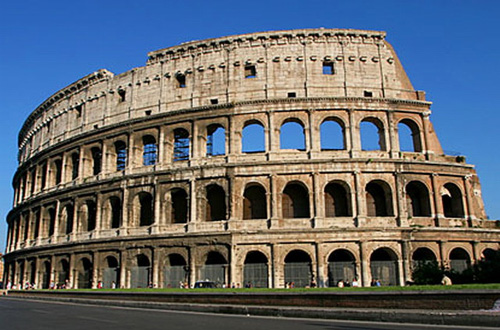
The Colosseum or Coliseum, also known as the Flavian Amphitheatre is an elliptical amphitheatre in the centre of the city of Rome, Italy. Built of concrete and stone, it was the largest amphitheatre of the Roman Empire, and is considered one of the greatest works of Roman architecture and engineering. It is the largest amphitheatre in the world. The Colosseum is situated just east of the Roman Forum. Construction began under the emperor Vespasian in 70 AD, and was completed in 80 AD under his successor and heir Titus. Further modifications were made during the reign of Domitian. These three emperors are known as the Flavian dynasty, and the amphitheatre was named in Latin for its association with their family name (Flavius).
The Colosseum was used for gladiatorial contests and public spectacles such as mock sea battles, animal hunts, executions, re-enactments of famous battles, and dramas based on Classical mythology. The building ceased to be used for entertainment in the early medieval era. It is now one of Rome's most popular tourist attractions. There is now a museum dedicated to Eros located in the upper floor of the outer wall of the building. Just outside the Coliseum is the Arch of Constantine (Arco di Costantino), a 25m high monument built in AD315 to mark the victory of Constantine over Maxentius at Pons Milvius.
As it has close connections with the Roman Catholic Church, as each Good Friday the Pope leads a torchlit "Way of the Cross" procession that starts in the area around the Colosseum.The Colosseum, was listed as a World Heritage Site by UNESCO in 1980. In 2007 the complex was also included among the New7Wonders of the World, following a competition organized by New Open World Corporation (NOWC).

Don't miss the exclusive news, Stay updated
Subscribe to our Newsletter
By subscribing you agree to our Terms & Conditions.